In early 2026, Physical AI is rapidly moving from a technical concept to a central stage in industrial applications, becoming a strategic focus for major economies and technology companies.
Physical AI in Industrial Deployment: From Concept to the Evolution of Controllers
1. What Is Physical AI?
Physical AI represents a paradigm shift in artificial intelligence—from the digital world to the physical world. While traditional AI excels at “seeing” and “hearing” within digital spaces, Physical AI embeds AI into physical entities, enabling them to possess a complete closed‑loop capability of perception → reasoning → decision‑making → action → feedback.
It is widely recognised that Physical AI refers to the deep integration of AI’s perceptual, decision‑making, and learning capabilities into physical systems such as robots, smart devices, and automated production lines, allowing them to autonomously perform tasks in complex, dynamic real‑world environments. A simpler definition is: enabling autonomous systems like cameras, robots, and self‑driving vehicles to perceive, understand, reason, and execute or coordinate complex actions within the physical world.
The core distinction between Physical AI and traditional AI is: Traditional AI “thinks,” while Physical AI “thinks and acts.” Physical AI systems not only analyse data and make judgments but also directly intervene in the physical world through robots, controllers, actuators, and other devices, continuously learning and evolving from real‑world feedback. It emphasises direct interaction with the physical environment—typically requiring the integration of sensors, vision systems, edge computing devices, robots, controllers, and industrial software systems to form a complete perception‑to‑execution loop in specific scenarios.
In early 2026, Physical AI is rapidly moving from a technical concept to a central stage in industrial applications, becoming a strategic focus for major economies and technology companies. At the Hannover Messe, the organisers defined Physical AI as an artificial intelligence system that can directly interact with the physical world—including machinery, production lines, and various types of robots.
2. Core Value of Physical AI in Industry
Physical AI is fundamentally reshaping the underlying logic of industrial manufacturing. Its core value manifests in three dimensions:
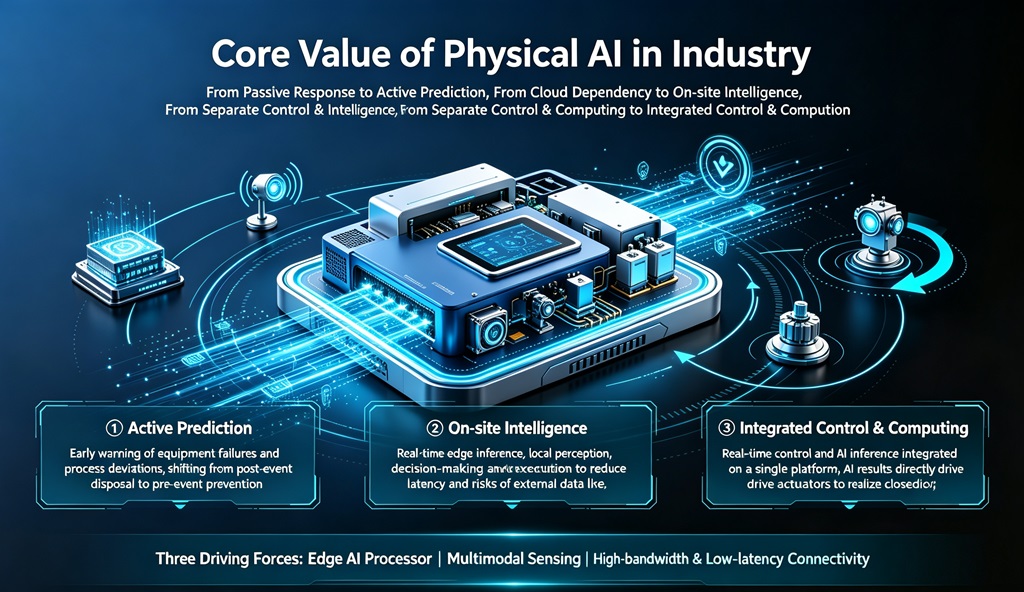
① From “reactive response” to “predictive proactivity” – Traditional industrial control systems only trigger alarms or shutdowns after parameters exceed limits, representing a typical “post‑event” mode. Physical AI, through real‑time edge inference and model prediction, can issue early warnings and proactively intervene before equipment failures or process deviations occur, transforming “fire‑fighting after the event” into “prevention before the event.”
② From “cloud dependency” to “on‑site intelligence” – Traditional AI solutions often require uploading data to the cloud for processing, which introduces uncontrollable latency, high bandwidth consumption, and security risks associated with transmitting production data externally. Physical AI pushes inference capabilities to the industrial edge, completing perception, decision‑making, and execution locally on the device, achieving millisecond‑level response while ensuring data security.
③ From “separated control and computing” to “unified control‑compute” – In traditional architectures, PLCs handle control, industrial PCs handle computing, and gateways handle communication—three independent devices stacked together, leading to complex architectures, high costs, and difficult maintenance. Physical AI, through edge controllers, integrates real‑time control and AI inference on a single platform, allowing AI results to directly reach actuators and achieve true closed‑loop autonomous control.
Physical AI has become feasible today thanks to the convergence of three forces: powerful edge AI processors capable of real‑time inference, advanced multimodal sensing technologies, and high‑bandwidth low‑latency wireless connectivity. Together, they enable intelligent systems that can perceive, decide, and act locally.
3. Key Challenges in Deploying Physical AI
Despite its immense value, Physical AI faces three critical bottlenecks in industrial deployment:
The contradiction between compute power and real‑time performance – Traditional controllers are highly stable but lack sufficient compute power to run AI models; general‑purpose computing devices have ample compute power but struggle to meet industrial real‑time control requirements. Physical AI requires a single device that simultaneously delivers “deterministic control” and “AI flexibility.”
The IT‑OT integration barrier – Information Technology (IT) and Operational Technology (OT) have long employed different technology stacks, data standards, and development paradigms, creating a natural divide. Physical AI systems must bridge this gap, enabling AI engineers and automation engineers to collaborate on a unified platform.
Complex deployment and high costs – The traditional “PLC + industrial PC + gateway” three‑device stack not only increases hardware costs but also adds complexity to system integration, cabling, and maintenance, hindering the large‑scale adoption of Physical AI.
4. Architectural Evolution of Physical AI Controllers
In response to these challenges, industrial controllers are undergoing a profound architectural transformation—from “pure control” to “unified control‑compute.” Current Physical AI controllers on the market can be broadly divided into two categories based on performance tiers: one targets mid‑to‑high‑end applications, balancing AI capability with cost control; the other targets the high end, delivering top‑tier compute power for the most demanding industrial scenarios. Below, we analyse two representative EdgePLC edge controller models from these categories.
EdgePLC Edge Controller – Mid‑to‑High‑End Physical AI Controller Representative: BL440
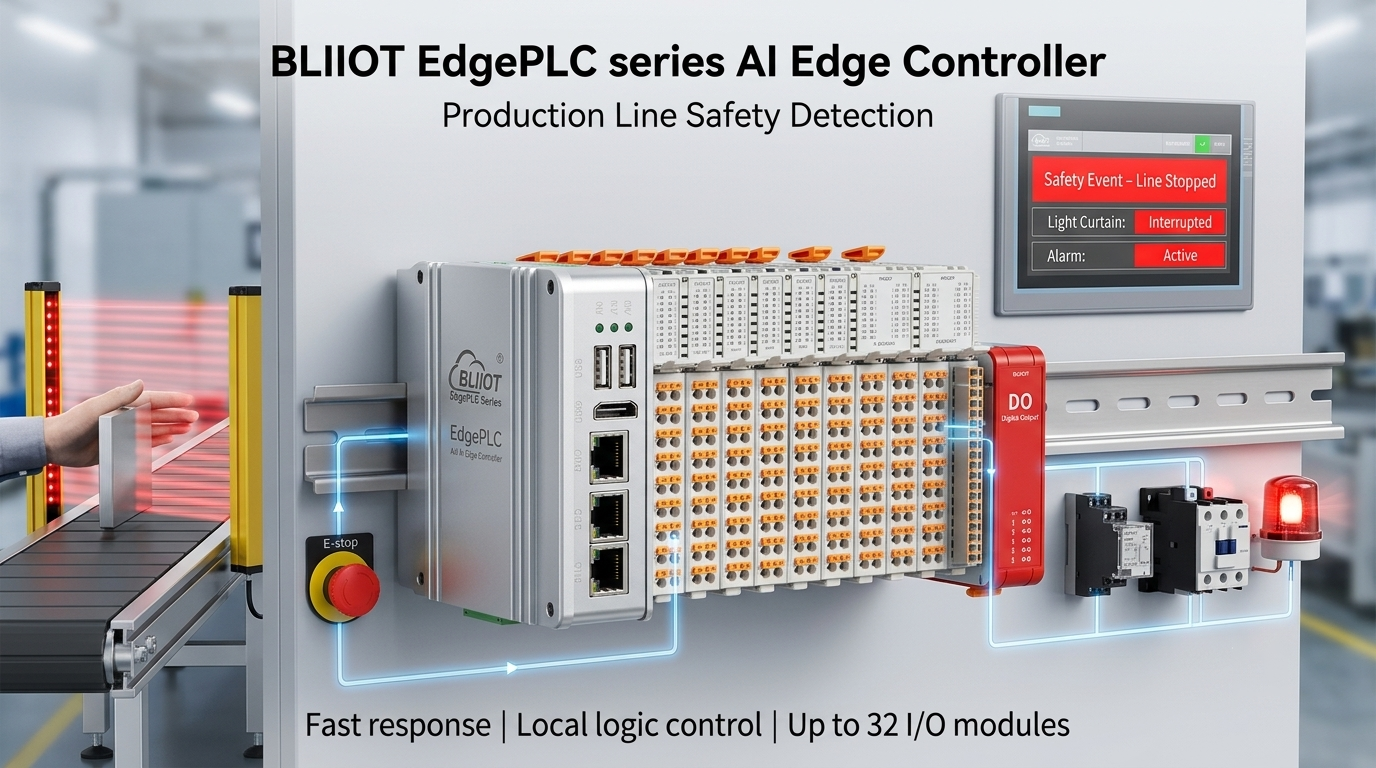
The EdgePLC BL440‑class Physical AI controller is built on a 4‑core ARM Cortex‑A72 + 4‑core ARM Cortex‑A53 architecture, with a maximum main frequency of 2.2 GHz. Its core AI engine is an integrated 6 TOPS NPU, supporting model inference from mainstream AI frameworks such as TensorFlow, PyTorch, and Caffe—sufficient to cover the vast majority of industrial AI workloads, including vision inspection, time‑series prediction, and anomaly detection.
Storage options include 16/32/64 GB eMMC and 2/4/8 GB LPDDR4X, allowing flexible configuration based on project requirements. Interface resources include 1~3 adaptive Ethernet ports, 2 USB3.2 ports, optional HDMI2.1, and a Mini PCIe expansion slot (supporting WiFi/4G/5G modules). In terms of I/O expansion, it supports flexible combinations of X‑series and Y‑series I/O boards, configurable with multiple RS485/232, DI/DO, AO/AI, PWM, thermocouple/PT100, IEPE high‑speed acquisition, and other interfaces—covering everything from conventional digital I/O to vibration signal acquisition. Video processing supports 4K@60fps H.264 encoding and 8K@30fps H.265 decoding.
On the software side, it supports Linux‑6.1.75, Linux‑RT‑6.1.75, Ubuntu 22.04, Debian 11, and Android 13, along with a complete toolchain including Docker containerisation, Node‑RED low‑code orchestration, BLIoTLink protocol conversion, and BLRAT remote operation and maintenance. AI engineers and automation engineers can collaborate on a unified platform. This series has undergone rigorous high‑ and low‑temperature testing and can operate stably in a ‑40°C to +85°C wide‑temperature environment, with DIN‑rail mounting for industrial field deployment.
The EdgePLC BL440 is suitable for embodied robots (inspection robots, collaborative robotic arms, AGV/AMR), energy storage EMS and energy management (PV storage, smart dispatch), smart cities and energy‑efficient lighting (AI‑driven on‑demand lighting with overall energy savings exceeding 60%), as well as machine vision and AIoT applications requiring 4K video processing.
The EdgePLC BL450‑class high‑end Physical AI controller achieves a more thorough “unified control‑compute” architecture. It is built on a heterogeneous computing architecture of 4‑core ARM Cortex‑A76 + 4‑core ARM Cortex‑A55 + 3‑core ARM Cortex‑M0—where the A76 high‑performance cores handle complex computing and AI inference, the A55 energy‑efficient cores manage routine tasks, and the M0 co‑processors are dedicated to real‑time control. This achieves physical isolation and coordination between “computing” and “control” at the chip level, fundamentally eliminating the interference between real‑time tasks and AI tasks that plagues traditional architectures.
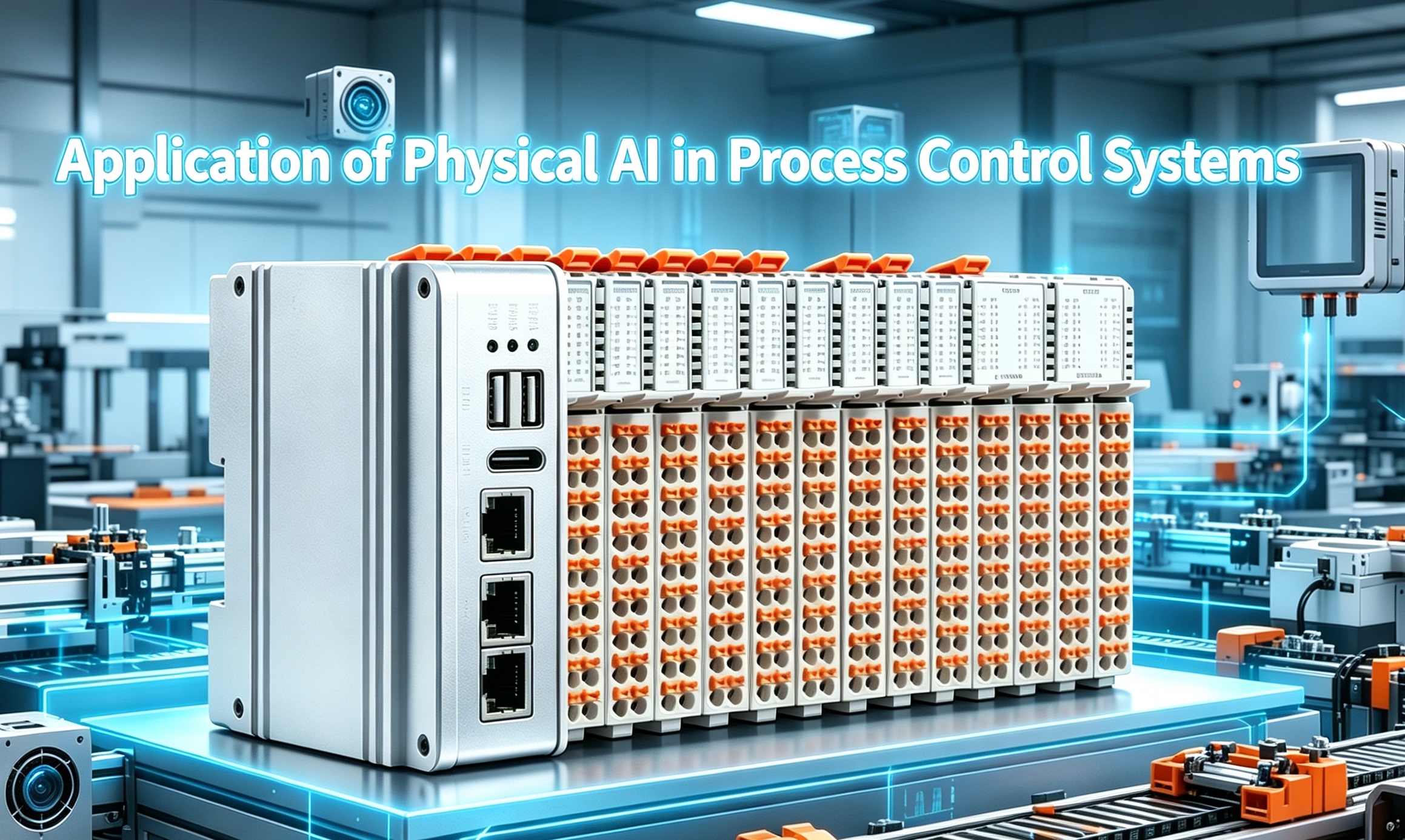
It also integrates a 6 TOPS NPU, supporting INT4/INT8/INT16/FP16/BF16/TF32 data precisions. Storage configurations are more generous, offering 32/64/128 GB eMMC and 4/8/16 GB LPDDR4X. Interfaces include 2~3 adaptive Ethernet ports, 2 USB3.1 ports, optional HDMI2.1 (supporting 8K output), and a Mini PCIe expansion slot. I/O expansion is even more powerful, supporting up to 32 distributed I/O modules covering all signal types: DI, DO, AI, AO, temperature/RTD, pulse/PWM, etc. Video processing capabilities are significantly enhanced, supporting 8K@30fps H.265/H.264 encoding and 8K@60fps H.265 decoding, meeting real‑time processing requirements for high‑resolution industrial vision inspection.
The software ecosystem covers the complete industrial control chain: OpenPLC, CODESYS Runtime (IEC 61131‑3 standard), IGH EtherCAT hard real‑time master (for high‑precision motion control and synchronous I/O), Docker containerisation, YOLOv5/8 + OpenCV vision stack, TensorFlow Lite, Grafana visualisation, BLRAT remote operation and maintenance, and more. This series supports wide‑temperature operation (‑20°C to +85°C), features high‑level EMC immunity, and includes an onboard independent hardware watchdog to ensure long‑term stable operation in harsh industrial environments.
The EdgePLC BL450 is designed for the most demanding Physical AI scenarios: 8K ultra‑high‑definition machine vision inspection (object detection and recognition from massive image data), high‑end motion control (multi‑axis synchronisation with CODESYS and IGH EtherCAT), complex AI model inference (running large‑scale deep learning models), predictive maintenance (combining IEPE high‑speed acquisition modules with edge AI analysis to transition from “reactive maintenance” to “predictive maintenance”), and AGV/autonomous mobile robots (integrating visual navigation, obstacle recognition, and motion control).
Positioning Differences Between the Two Controller Types
Both share the 6 TOPS NPU as the core AI engine and a similar software ecosystem and I/O expansion philosophy. The primary differences lie in performance hierarchy and target scenarios:
5. Conclusion
Physical AI is leading industry in a paradigm shift from “automation” to “cognitive manufacturing.” It enables machines not only to “execute” but also to “perceive, think, and act,” completing a full closed loop from data acquisition to intelligent decision‑making to precise execution. The true deployment of this loop requires controllers that achieve deep integration of real‑time control and edge AI at the architectural level.
From the EdgePLC BL440 mid‑to‑high‑end controller to the EdgePLC BL450 high‑end flagship, Physical AI controllers are continuously evolving along the path of “more compute power, more real‑time, more integrated.” From on‑demand lighting in smart cities to 8K vision inspection on production lines, from intelligent dispatch in energy storage systems to navigation and obstacle avoidance in autonomous mobile robots, Physical AI is unleashing value in every corner of industry—and this is only the beginning.


