Can AI inference and real-time control coexist on one EdgePLC platform? Explore how CODESYS, AI workloads, deterministic control, and data acquisition can work together—and what engineers should consider when designing reliable Industrial AI and edge computing systems.
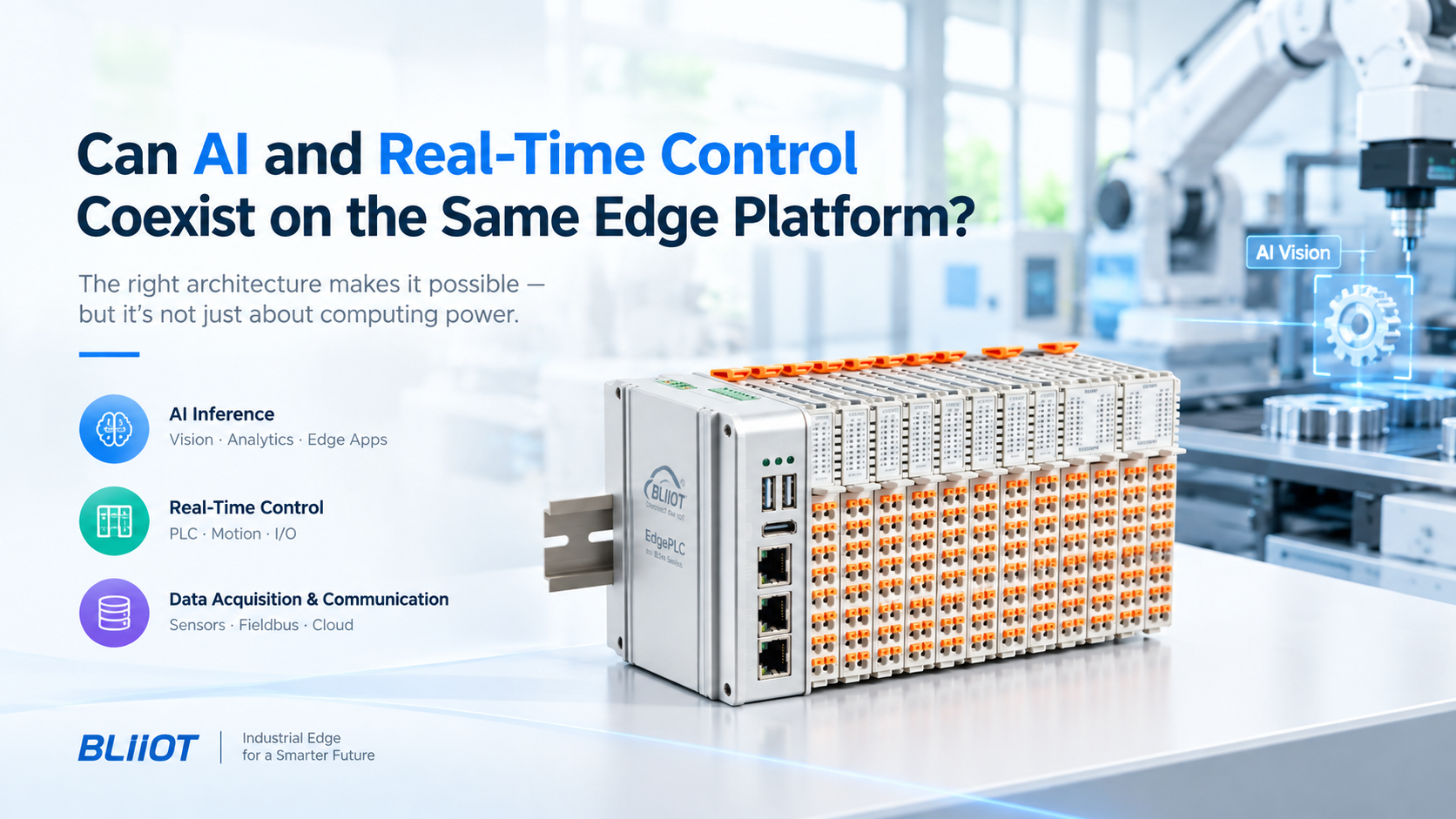
AI is moving closer to industrial machines.
Machine vision can identify defects. Edge AI can detect abnormal patterns. Local data processing can reduce cloud dependency.
But when these workloads run alongside machine control, an important engineering question emerges:
Can AI inference and real-time control reliably coexist on the same edge platform?
The answer is yes — in the right architecture. But combining them in one device does not automatically guarantee deterministic control.
1. High AI Performance Does Not Guarantee Real-Time Control
AI inference and industrial control have fundamentally different requirements.
An AI vision task may need substantial computing resources to process an image or run a model. Its execution time may vary with the model, input data and system workload.
A control task, however, must execute within defined timing requirements. Reading inputs, evaluating logic, updating outputs and coordinating motion cannot simply wait until an AI task finishes.
If both compete for CPU time, memory bandwidth, storage or communication resources, a powerful processor alone cannot guarantee that every control cycle will meet its deadline.
Computing performance and control determinism are two different engineering challenges.
2. The Key Is How Workloads Are Organized
A practical edge architecture should distinguish between three responsibilities:
Real-time control
PLC logic, I/O updates, interlocks and time-critical machine sequences belong in a properly configured control environment.
AI inference and edge applications
Machine vision, defect classification and anomaly detection can run as edge workloads, provided their computing demands and timing requirements have been evaluated.
Data acquisition and communication
Sensor data, machine status and production information need to be collected and exchanged without creating unacceptable delays or interference with control tasks.
These functions can share one platform, but they should not be treated as if they have identical priorities or timing requirements.
The engineering objective is not simply to run everything together. It is to define what must happen on time, what can run asynchronously, and how the system behaves when resources become constrained.
3. What Should Engineers Evaluate Before Deployment?
Before putting AI and control workloads on the same edge controller, consider five questions:
- Task scheduling: Can the control task meet its required cycle time under realistic system load?
- Resource competition: What happens when AI inference, data processing and communication peak simultaneously?
- Fault isolation: Can an overloaded or failed AI application be prevented from disrupting essential control functions?
- Communication interfaces: How are the controller, distributed I/O, cameras and external systems connected, and what latency or jitter can those paths introduce?
- Failure behavior: If the AI application stops responding or loses its data source, does the machine remain in a defined and safe operating state?
These questions should be validated through measurements and stress testing, not answered by processor specifications alone.
A further distinction matters: real-time scheduling and fault isolation are not the same as functional safety. Safety-related functions require their own appropriate design and validation.
4. Where Does EdgePLC + CODESYS Fit In?
This is where an integrated industrial edge controller becomes interesting.
The BLIIOT EdgePLC BL244 is designed to bring industrial control, edge AI computing and distributed I/O expansion together on one platform.
According to its datasheet, the BL244 supports:
- CODESYS and other IEC 61131-3 programming environments for industrial logic control.
- Linux-RT and Ubuntu 22.04 operating environments.
- An integrated 6 TOPS NPU for supported AI inference workloads.
- IGH EtherCAT Master for hard real-time EtherCAT communication.
- Up to 32 N-series I/O modules, covering digital and analog I/O, relay outputs, temperature measurement and other I/O functions.
- Docker, Python/C++ and Node-RED for application development, data processing and integration.
The CODESYS environment provides an established framework for PLC logic programming and, depending on the licensed configuration, motion-control functions.
This creates an opportunity to organize machine control, AI applications and data acquisition on a common industrial platform rather than automatically distributing every function across separate devices.
However, the available capabilities are not a blanket guarantee that every workload can run simultaneously without interference. The selected hardware and software configuration, control-cycle requirements, AI workload, scheduling strategy and communication architecture all need to be assessed.
5. One Platform Does Not Mean One Uncontrolled Workload
Imagine a machine vision inspection station.
A camera captures an image, an AI model evaluates a potential defect, and the PLC coordinates machine sequencing and the reject mechanism.
The AI result may inform the control decision, but the control system still needs to account for inference latency, communication delays, missing results and timing limits.
The critical design question is not simply whether the controller can run the AI model.
It is whether the complete path — from image acquisition to inference, decision and physical action — meets the application's timing and failure-handling requirements.
That is the difference between demonstrating AI on an edge device and engineering a dependable industrial system.
The Bigger Question
As industrial edge platforms become more capable, the next step is not merely adding more TOPS or more applications.
It is designing a clear boundary between deterministic control and workloads whose timing is less predictable — while making both work together effectively.
If you were designing an AI-enabled machine today, would you prioritize a single integrated edge platform, or separate controllers for AI and real-time control? What would determine your choice?


