In the industrial touch panel PC market, ARM architecture has steadily gained share in embedded systems—data shows that by 2025, ARM holds about 65% of the embedded development platform market, while traditional X86 has declined to around 12%.
Comparative Analysis of ARM-Based and X86-Based Touch Panel PCs: Strengths and Use Cases
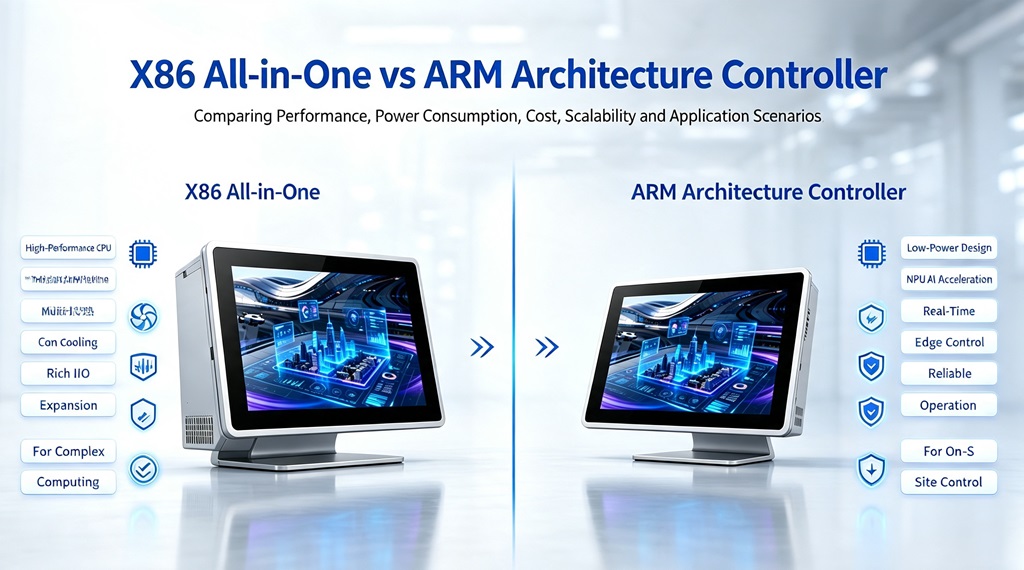
In the industrial touch panel PC market, the ARM and X86 processor architectures each hold significant positions. In recent years, ARM architecture has steadily gained share in embedded systems—data shows that by 2025, ARM holds about 65% of the embedded development platform market, while traditional X86 has declined to around 12%. Nevertheless, this does not mean X86 will be entirely replaced; both architectures offer unique, irreplaceable advantages for different application scenarios. This article takes the Bliiot TPC410 series ARM-based touch panel PC as an example to objectively compare the core strengths of both architectures, helping readers make informed decisions.
I. Core Advantages of ARM-Based Touch Panel PCs
1. Ultra‑low power consumption and fanless design
ARM processors use a RISC (Reduced Instruction Set Computer) architecture, renowned for low power draw. In real industrial settings, ARM controllers typically consume only 3–5 W, whereas X86 industrial PCs often run at 30–100 W. The TPC410 series, powered by the Rockchip RK3568 quad‑core Cortex‑A55 processor at 2.0 GHz, adopts a fanless passive cooling design. This not only drastically reduces energy consumption but also enables silent operation, lowers maintenance needs, and prevents dust ingress. These benefits are especially valuable for 24/7 continuous operation, space‑constrained embedded installations, and noise‑sensitive environments.
2. Excellent environmental adaptability and industrial‑grade protection
ARM‑based industrial panel PCs often feature fully enclosed, fanless designs that provide superior dust and water resistance. The TPC410 series achieves IP66 front‑panel protection and IK08 impact resistance, with an operating temperature range from ‑30 °C to 70 °C. It can withstand extreme cold, intense heat, bright light, dust, vibration, and harsh electromagnetic conditions. In contrast, X86 systems, due to higher power dissipation, typically require active cooling or bulky passive heat sinks, making them less flexible in extreme deployment scenarios.
3. Built‑in NPU for powerful edge AI capabilities
Modern ARM processors commonly integrate an NPU (Neural Processing Unit), providing hardware acceleration for edge AI workloads. The TPC410 includes a 1‑TOPS NPU and supports mainstream AI frameworks such as TensorFlow, PyTorch, and Caffe, enabling smooth execution of vision inspection, predictive analytics, and other edge intelligence tasks. This gives ARM‑based systems a natural edge in AIoT applications like industrial visual inspection and intelligent analysis.
4. Significant cost advantage
At equivalent computing power, ARM chips are generally less expensive than X86 processors, and their simpler peripheral circuitry helps reduce overall system cost. Market data indicates that ARM‑based products typically range from RMB 1,500 to 4,000, while X86 solutions usually fall between RMB 4,000 and 8,000. For large‑scale deployments (hundreds of units or more), this cost difference is substantial.
5. Rich operating system choices
ARM‑based panel PCs support a variety of operating systems, including Linux, Yocto, Ubuntu, Debian, and Android, and natively work with development tools like Docker, Node‑RED, Python, and Qt, offering developers flexible options.
6. Open and comprehensive software ecosystem with proprietary toolchains
Taking the TPC410 as an example, ARM‑based systems not only benefit from the extensive Linux open‑source ecosystem but also come with a full suite of proprietary software tools that cover the entire industrial project lifecycle, greatly reducing development and maintenance overhead:
-
QuickConfig – An all‑in‑one rapid configuration tool that handles network management, system settings, storage monitoring, application extensions, and an AI development assistant. It enables one‑click initialisation and batch deployment, allowing operators to perform complex configurations without delving into Linux command lines.
-
BLIoTLink – A free embedded IoT protocol conversion software that supports bidirectional translation between numerous industrial protocols, including Modbus, DL/T645, IEC104, BACnet, OPC UA, MQTT, SNMP, and IEC61850. It seamlessly connects various PLCs with cloud platforms (Alibaba Cloud, Huawei Cloud, Bliiot Cloud, etc.), serving as a bridge between OT (Operational Technology) and IT.
-
EdgeCoder – A lightweight web‑based development and operations tool that lets developers edit code, manage terminals, handle files, and perform AI‑assisted analysis directly from a browser—without installing any local development environment. It is especially suitable for rapid iteration and remote debugging at field sites.
-
BLRAT – A remote access tool that uses token‑based authentication and secure tunnels to virtualise distributed devices (located in photovoltaic plants, power substations, wind farms, pump stations, metro equipment rooms, etc.) into a single IP address. Engineers can perform remote debugging, troubleshooting, and system upgrades without travelling to the site.
-
CODESYS and IEC 61131‑3 programming support – The TPC410 supports Linux‑RT real‑time control, the IGH EtherCAT master stack, and IEC 61131‑3 compliant programming environments such as OpenPLC, NexPLC, and CODESYS. This enables the device to act not only as an HMI (Human‑Machine Interface) but also as a PLC (Programmable Logic Controller), achieving an integrated “HMI+PLC” solution.
Together, these software tools form a complete lifecycle loop: deployment (QuickConfig), connectivity (BLIoTLink), application development (EdgeCoder), remote maintenance (BLRAT), and industrial control (CODESYS). They ensure that ARM‑based systems offer robust software support even in demanding industrial scenarios.
II. Core Advantages of X86‑Based Touch Panel PCs
1. Superior general‑purpose computing performance
X86 processors, based on the CISC (Complex Instruction Set Computer) architecture, can perform multi‑step operations with a single instruction, making them well‑suited for complex tasks. They typically feature higher clock speeds and larger caches, excelling in large‑scale data acquisition, sophisticated image processing, and multi‑threaded workloads. For floating‑point intensive applications, X86 processors leverage instruction sets like AVX‑512 to deliver significant performance gains. For high‑performance computing demands—such as advanced industrial vision systems, large‑screen industrial PCs, or edge servers—X86 remains the preferred choice.
2. Unmatched software ecosystem and compatibility
With over 40 years of evolution, X86 architecture boasts the world’s most comprehensive software ecosystem. Almost all X86 hardware can directly run Windows and virtually every mainstream tool available. From SCADA systems to MES platforms, X86 processors can execute more than 90% of industrial software without additional adaptation. Many legacy configuration tools are available only in X86 versions, making migration to ARM a cumbersome process. For applications that require a standard Windows environment and traditional industrial software, X86 is irreplaceable.
3. Flexible hardware expandability
X86 systems use a “bridge” architecture to connect peripheral devices, allowing relatively easy performance upgrades—such as adding memory or storage. They also offer broad hardware compatibility, simplifying integration with other equipment. For scenarios that demand frequent hardware upgrades or functional expansion, X86 provides greater flexibility.
4. Mature development and maintenance ecosystem
Given the widespread adoption of X86, development and maintenance tools are readily available and well‑documented. A mature toolchain, abundant technical documentation, and a large developer community enable shorter project cycles and lower maintenance costs for X86‑based solutions.
III. Core Strengths at a Glance
IV. Selection Guidelines: Choose According to Your Needs
Consider ARM‑based platforms (like the TPC410) if you require:
-
Relatively lightweight tasks—simple HMI operations, basic data entry, barcode scanning, etc.
-
Continuous 24/7 operation with strict power and thermal constraints.
-
Deployment in harsh environments with wide temperature ranges, high dust, or strong vibrations.
-
Edge AI inference capabilities (e.g., vision inspection, predictive maintenance).
-
Rapid deployment, protocol conversion, and remote maintenance via a comprehensive proprietary toolchain.
-
Large‑scale projects where cost efficiency is critical.
Choose X86‑based platforms if you need:
-
Native Windows and traditional industrial configuration software (e.g., WinCC, KingView).
-
High‑performance computing, complex image processing, or heavy multitasking.
-
Frequent hardware upgrades (memory, storage, etc.).
-
Short development cycles and want to leverage the mature, extensive X86 developer ecosystem for fast time‑to‑market.
Conclusion
ARM and X86 are not direct substitutes—they are optimal solutions for distinct application scenarios. As ARM architecture continues to improve in compute power, software ecosystem, and industrial compatibility (as exemplified by the TPC410’s complete toolchain and CODESYS support), its applicability in industrial touch panel PCs is steadily expanding. Meanwhile, X86 remains firmly entrenched in high‑end, complex applications thanks to its superior performance and Windows ecosystem dominance. When making a selection, companies should evaluate multiple dimensions—power consumption, performance, environmental resilience, software compatibility, scalability, and total cost of ownership—to choose the architecture that best fits their specific business needs.


