One Device Eliminates PLC Engineer Travel Costs: How the EdgeIO BL192Pro Cuts Custom Automation Project Costs in Half and Doubles Delivery Speed
Case Details
One Device Eliminates PLC Engineer Travel Costs: How the EdgeIO BL192Pro Cuts Custom Automation Project Costs in Half and Doubles Delivery Speed
1. The Three Hidden Pains of Custom Automation Business Owners
What do custom automation business owners fear most?
First, projects that "lose money the more you do them." Take a small project with just a few dozen I/O points – the customer's budget is tight. You do the math: PLC costs, I/O module costs, protocol gateway costs, cloud gateway costs – before you've even sourced the hardware, the budget is already blown. And that's before counting the PLC engineer's billable hours – a single on‑site trip for commissioning costs thousands.
Second, customers who "change requirements faster than you can flip a page." It's custom automation, after all – today they want two more sensors, tomorrow a different instrument, and the day after they want cloud data dashboards. Every change means modifying the PLC program and re‑commissioning – engineers are constantly on the road.
Third, after‑sales support that is "a maintenance nightmare." Once the equipment is delivered, the customer calls with a "small issue" – and you have to fly an engineer over. Flights + accommodation + billable time – easily a few thousand dollars per trip. Over the course of a year, after‑sales costs eat up most of your profit.
What's the root cause behind these problems? The traditional architecture is too "heavy" – PLC + I/O modules + protocol gateway + cloud gateway – four devices stacked together. Heavy on cost, heavy on commissioning, heavy on maintenance.
Bari Technology's EdgeIO Edge Controller BL192Pro is designed specifically to solve these problems – one device replaces the cumbersome combination of "PLC + I/O modules + protocol gateway + cloud gateway" , turning custom automation projects from "heavy‑asset" to "light‑cavalry".
2. What is the BL192Pro? One Device Does the Work of Four
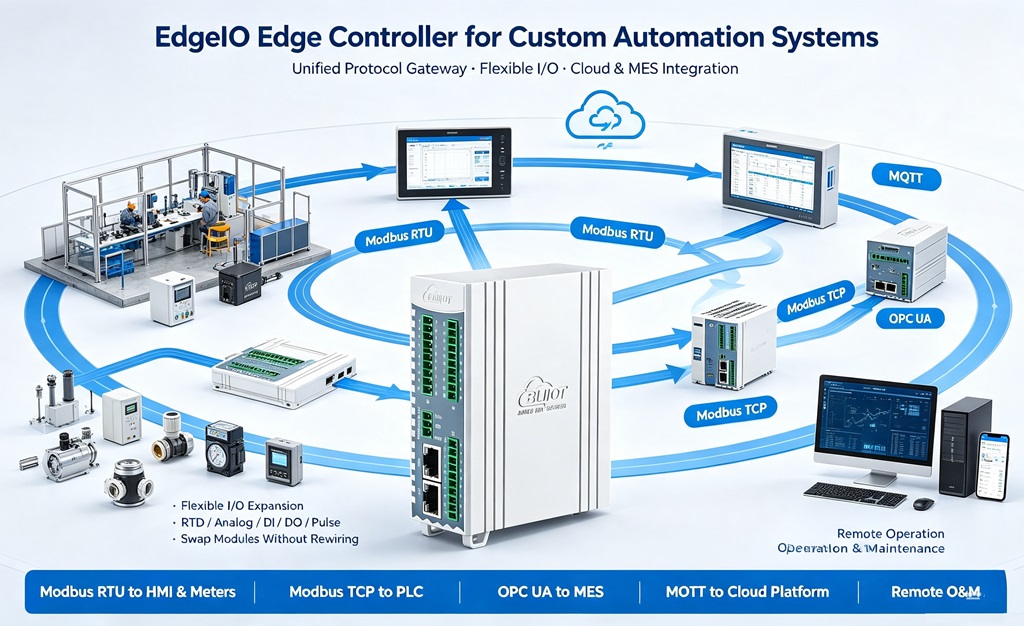
The BL192Pro is a DIN‑rail‑mounted multi‑protocol edge I/O controller, specifically designed for industrial IoT and smart manufacturing. It integrates three core capabilities:
Acquisition – collects field sensor and instrument signals via Y‑series I/O expansion boards
Control – built‑in edge computing executes local logic control
Communication – natively supports MQTT, Modbus TCP, and OPC UA simultaneously
One BL192Pro equals the combination of "PLC + I/O modules + protocol gateway + cloud gateway". Hardware costs are cut in half, cabling is simplified, points of failure are reduced, and commissioning time is dramatically shortened.
3. Flexible I/O Selection: "Get What You Need" for Each Project
The defining characteristic of custom automation is that every project is different – the types and quantities of I/O required vary enormously.
What does a traditional approach do? PLC I/O point counts are often fixed – too many wastes budget, too few leaves you short. You have to estimate and leave margin, which usually means "buy bigger than needed" and throw money away.
The BL192Pro offers 1~3 Y‑series I/O expansion slots, allowing free combination of over 20 module types – digital, analogue, temperature, serial, pulse, and more. Supporting more than 26 I/O board types, it can generate over 10,000 possible configurations.
Here's an example: a typical small custom machine needs 8 DI for switch signals, 4 AI for sensors, and 2 PT100 inputs for temperature – you simply choose Y11 (8DI) + Y31 (4AI) + Y51 (2‑channel PT100) . Three boards handle all signal acquisition. If the next project requires DI + thermocouple + pulse counting? Just swap the three boards – the host controller stays the same.
"Configure on demand, expand flexibly" – the dreaded "requirement change" in custom projects is no problem for the BL192Pro. Just swap a board – no need to replace the whole unit or re‑wire.
4. IT/OT Convergence: One Device, Three Uses, Breaking Down Data Silos
One of the most frustrating issues in custom automation is protocol incompatibility.
Field sensors use hardwired signals; the HMI touchscreen speaks only Modbus RTU; the customer requires cloud dashboards (MQTT); the factory MES demands OPC UA. What does a traditional solution do? PLC acquires signals, plus a protocol gateway for Modbus, plus a cloud gateway for MQTT, plus an OPC UA gateway – devices keep piling up, commissioning gets increasingly complicated.
The BL192Pro natively supports MQTT, Modbus TCP, and OPC UA simultaneously – one device handles all protocol conversions:
-
As a Modbus RTU slave – connects to existing HMIs and touchscreens; existing operator habits are fully preserved
-
Via MQTT to the cloud – connects directly to Alibaba Cloud, Huawei Cloud, AWS IoT, ThingsBoard, and other platforms
-
Via OPC UA – exposes data to upper‑layer management systems (MES, ERP, SCADA) through a standardised interface
One data source, delivered to three destinations simultaneously. From field devices to cloud to IT systems – the entire data path is connected.
5. Preserve Existing Investment: Keep the HMI, No Retraining
Custom automation projects often face an awkward situation: the customer already has an HMI touchscreen on the production line, and operators are used to it. Any automation retrofit must not change the HMI, alter the interface, or require operator retraining – otherwise the customer won't approve.
The BL192Pro can operate as a Modbus RTU slave, emulating the original device's Modbus address mapping. The existing HMI can read/write device status (reading DI, writing DO commands) with zero modification – exactly as before.
What does that mean? The customer's existing investment is fully preserved. You don't have to re‑develop the HMI screen, retrain operators, or disrupt production during the retrofit.
A real‑world case: a 10‑year‑old stamping line at an auto parts factory had a PLC brand that was discontinued and failing frequently. After replacing the original PLC and I/O modules with the BL192Pro, the existing HMI worked directly with zero changes – the operator interface remained completely unchanged.
6. Remote O&M: Engineers No Longer Need to "Fly Everywhere"
This is the most compelling value of the BL192Pro for custom automation business owners – eliminating engineers' travel costs.
In a traditional setup, once equipment is delivered, any issue (parameter adjustment, firmware update, fault diagnosis) requires an engineer to fly on‑site. Each trip – flights + accommodation + billable hours – costs at least a few thousand dollars. Over a year, after‑sales support eats up most of your profit.
The BL192Pro integrates BLRAT, Bari Technology's proprietary free remote access tool. Engineers sit in the office and can accomplish, over the network:
Real‑world data shows that with the BL192Pro, on‑site maintenance visits are reduced by 80%, and annual downtime drops from about 40 hours to under 10 hours.
"Get the job done without traveling" – for custom automation businesses, this saves not just travel expenses, but also engineers' precious time and project response speed.
7. Web‑Based Configuration and Programming: No Dependence on PLC Engineers
Traditional PLC solutions carry another hidden cost: PLC engineers are expensive and hard to find. A skilled PLC engineer commands a high salary and often has a packed schedule. Assigning one to a small project is overkill and burns budget.
The BL192Pro performs all configuration and logic programming through its built‑in Web server. On‑site engineers just need a laptop and an Ethernet cable – connect to the device's IP address and open the browser for full configuration.
Logic programming is entirely Web‑based and code‑free – simply configure conditions, trigger relationships, and output actions through web page drop‑down menus. For example: "When AI1 temperature exceeds 35°C and DI1 fan is not running, automatically close DO1 to start the exhaust fan" – all configured through web drop‑downs.
No need to learn PLC ladder logic or ST language, no need to install proprietary software – a regular electrical engineer can get started in half a day.
What does that mean? You don't need to hire a dedicated PLC engineer. Ordinary electrical engineers can be productive after a short half‑day training – the "human resource barrier" is dramatically lowered.
8. Who Should Use the BL192Pro?
The BL192Pro is not meant to replace large PLCs – it is best suited for small, logic‑simple, low‑point‑count custom automation projects:
-
Standalone automation equipment – e.g., packaging machines, filling machines, small test equipment
-
Simple interlock/alarm control – e.g., automatic pump control, fan interlocking
-
Distributed equipment monitoring – data collection and remote monitoring across multiple stations
-
Legacy equipment intelligent retrofits – replacing obsolete PLCs while preserving existing HMIs
-
OEM equipment integration – adding remote O&M capabilities to factory‑shipped equipment
These projects share common characteristics: few I/O points (tens of points), simple logic (conditional judgments + basic operations), yet demanding flexibility, affordability, and easy maintenance. The BL192Pro is tailor‑made for exactly these scenarios.
9. Cost Comparison: How Much Can the BL192Pro Save You?
Taking a small custom automation project as an example (about 20 I/O points, requires cloud monitoring, and requires preserving the existing HMI):
Hardware costs are reduced by over 50%, and total comprehensive costs can be cut by up to 80%. More importantly, subsequent annual remote O&M generates virtually no travel expenses – every dollar saved goes straight to your bottom line.
10. Conclusion
For custom automation business owners, the BL192Pro solves not just a technical problem, but a business problem:
-
Cost: one device replaces four – hardware costs cut in half, comprehensive costs reduced by up to 80%
-
Flexibility: modular I/O configured on demand – project changes just mean swapping a board
-
Convergence: native MQTT, Modbus TCP, and OPC UA – bridging OT and IT seamlessly
-
Preservation: operates as a Modbus slave to connect to existing HMIs – customer investment fully protected
-
People: Web‑based code‑free configuration – ordinary electrical engineers can handle it, no dependence on PLC specialists
-
Travel: BLRAT remote O&M – engineers rarely need to fly on‑site, reducing field visits by 80%
One BL192Pro transforms custom automation projects from "heavy‑asset, high‑cost, long‑cycle" to "lightweight, low‑cost, fast‑delivery."
Keywords: EdgeIO Edge Controller | BL192Pro | Custom Automation | Non‑Standard Automation | IT/OT Convergence | Remote O&M | BLRAT | Code‑Free Programming | Web Configuration | MQTT Cloud Platform | OPC UA | Modbus | Cost Savings | Small Automation


